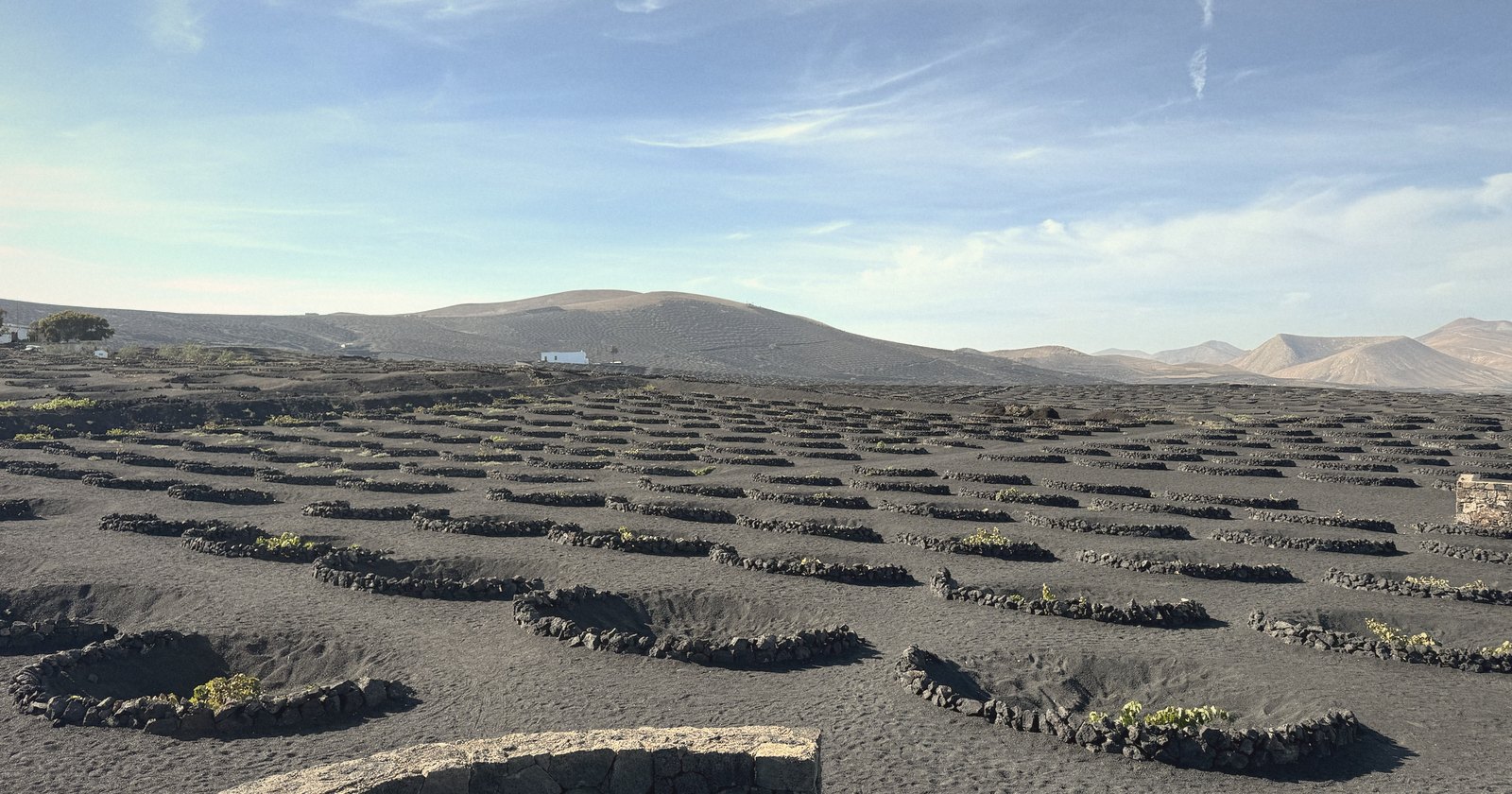
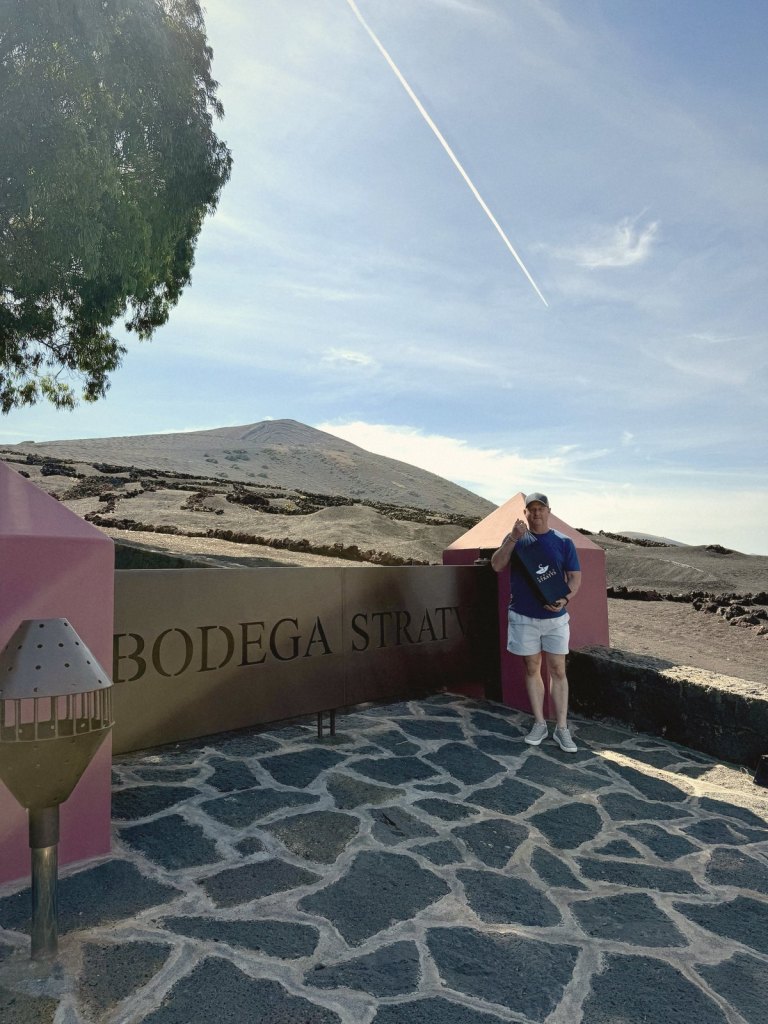
When we booked this trip we did not notice that two of its wine days told the same story. Colares, outside Lisbon, grows its vines in sand that phylloxera could not get through. Five days later, on Lanzarote, the vines grow in volcanic ash, and phylloxera never arrived there either. We took the ship’s wine tour into La Geria, the island’s wine country, for tastings at two bodegas, Stratvs and Rubicón.
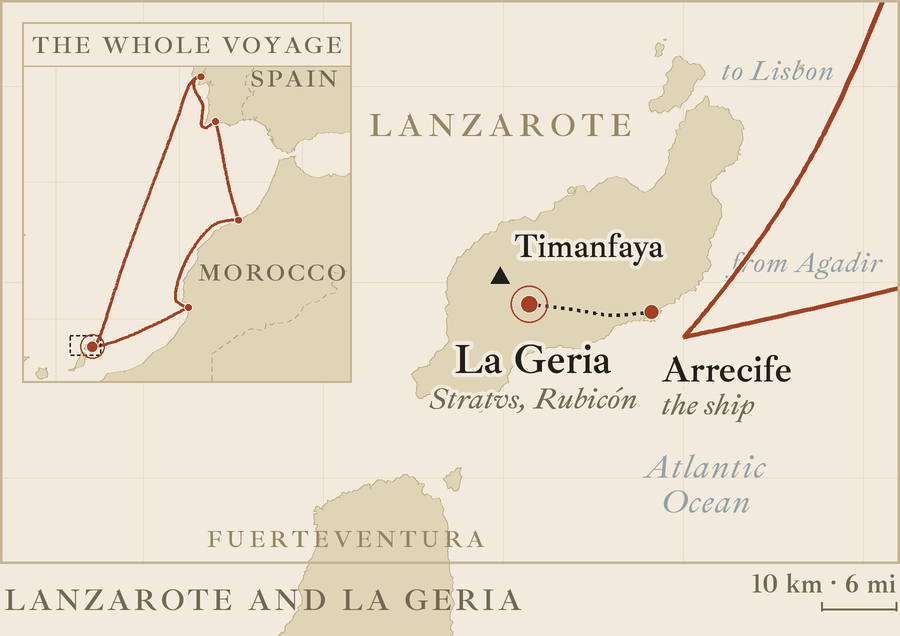
The ship docks in Arrecife’s commercial port. Industrial again, like Casablanca and Agadir, but on Lanzarote the reason to come is inland.
La Geria
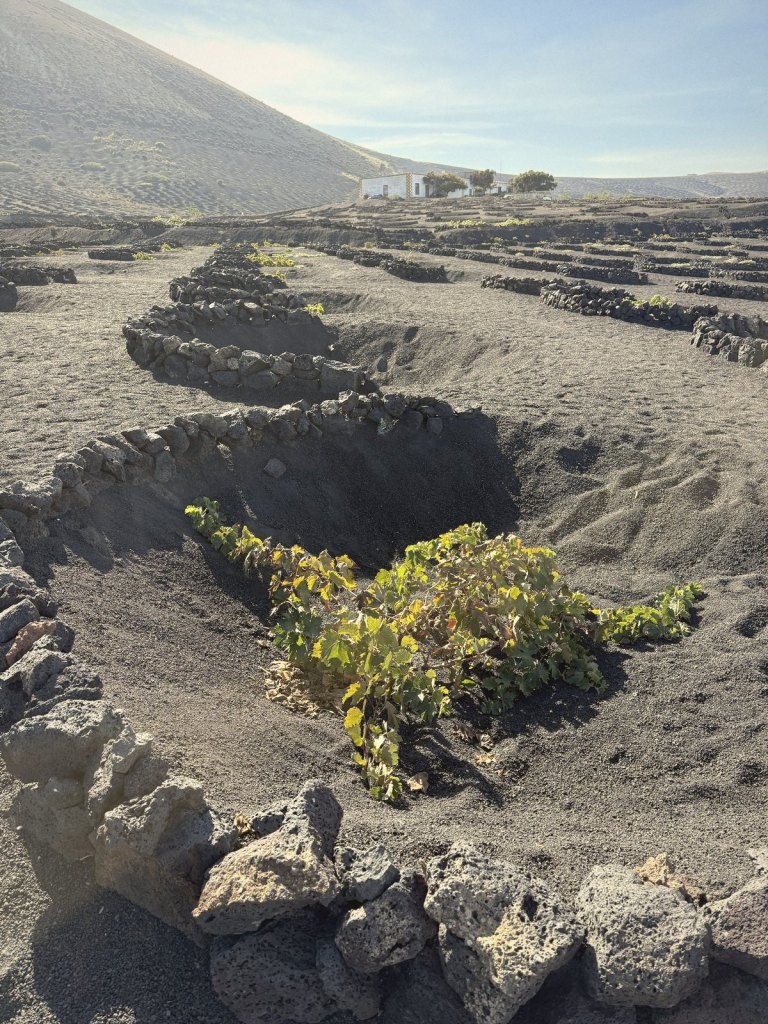
Between 1730 and 1736, eruptions at Timanfaya buried much of the island under lava and ash. In La Geria, the island’s farmers worked out how to grow vines in it anyway. They dug a pit down through the ash to the old soil underneath, planted the vine at the bottom, and built a low half-circle wall of lava stone on the windward side to keep off the trade winds. The pits are called hoyos and can be up to three metres deep. The walls are zocos. The whole valley is laid out like this.
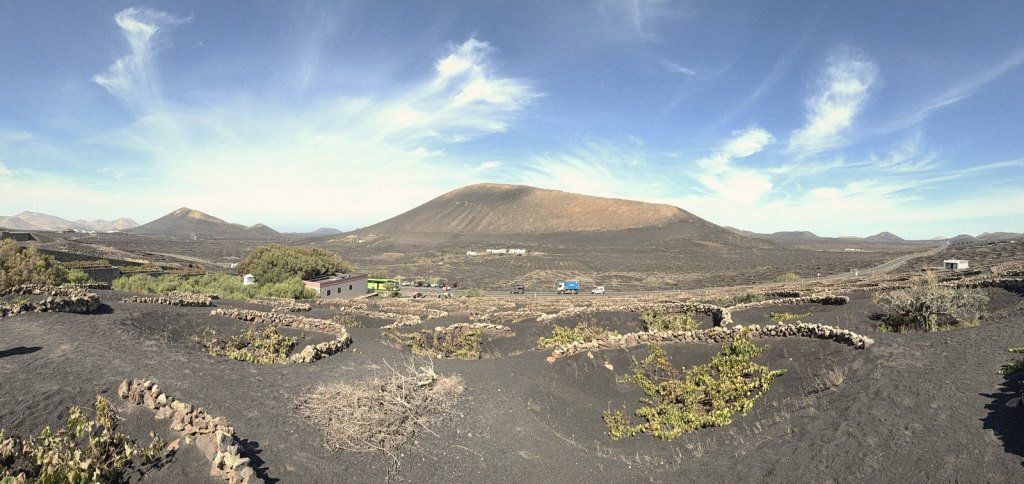
It hardly ever rains here. We were told about nineteen days a year. The ash does the watering: it is porous, catches the dew and the damp in the trade winds, and holds it against the roots.
Lanzarote is also the first wine region in Europe to harvest each year, with picking under way in July. And, like Colares, the vines grow on their own roots. Phylloxera, the louse that destroyed most of Europe’s vineyards in the nineteenth century, never reached the island.
Stratvs
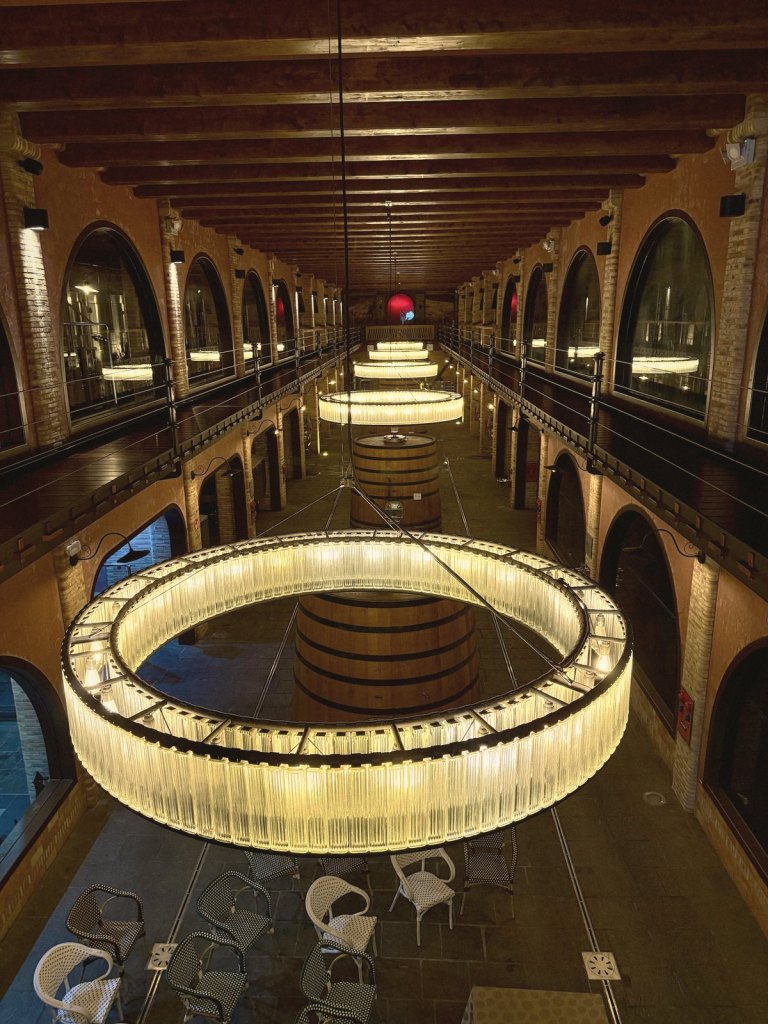
Stratvs is the young one. It opened in 2008 in a ravine at the foot of Timanfaya, and much of the building is set down into the slope. Inside is a long hall hung with rings of glass light, with a giant cask in the middle and arched windows onto the steel tanks.
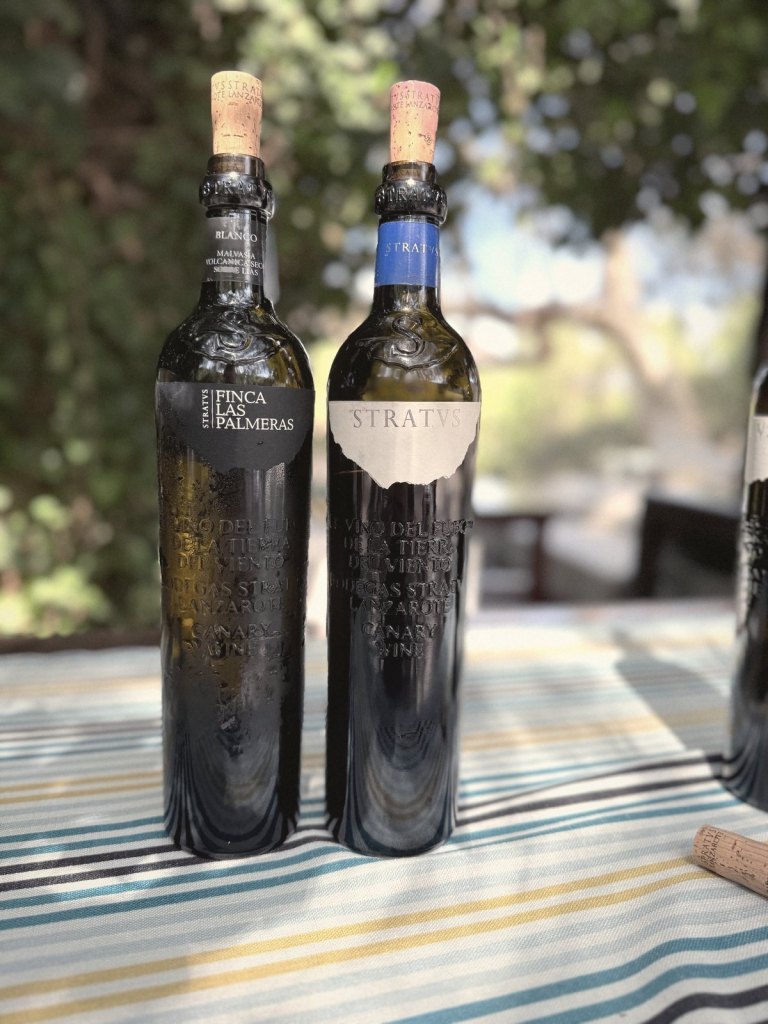
We tasted at a table outside, under the trees. The bottles are embossed with el vino del fuego, de la tierra, del viento: the wine of fire, earth and wind. Finca Las Palmeras is a dry Malvasía Volcánica, aged on its lees. Malvasía Volcánica is the island’s own grape, and most of the vineyard is planted with it.
Rubicón
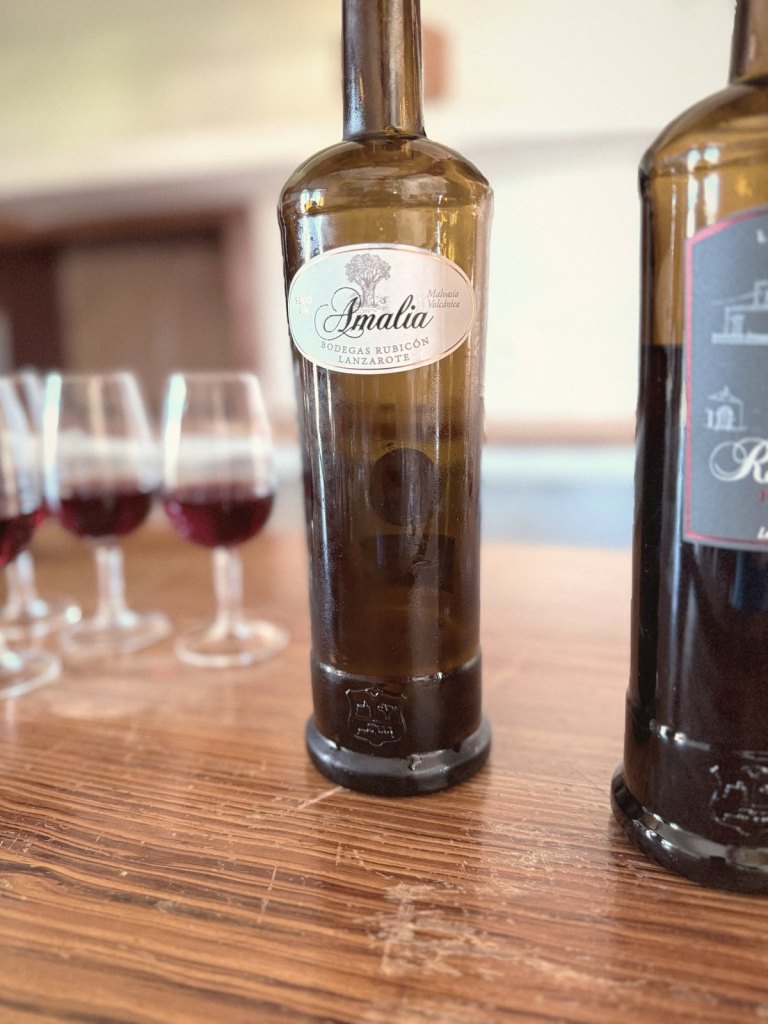
Rubicón is the old one. Wine has been made on the estate for more than three centuries. Germán López Figueras bought it in 1979, mainly for its winery, and his family still runs it, among old eucalyptus trees in the middle of La Geria. The tasting included Amalia, their dry Malvasía Volcánica, and reds.
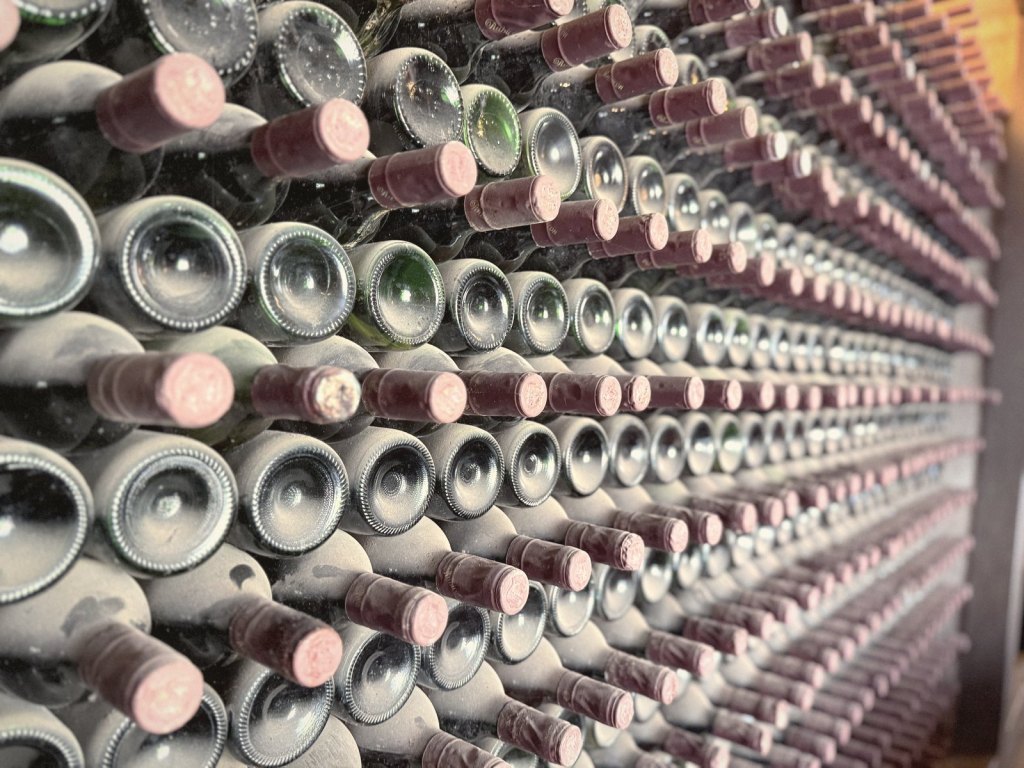
One wall is nothing but Rubicón’s own bottles, laid on their sides with the necks out, thick with dust.
What it takes
The wine here is heavily subsidised. We were told that without the money it could not be made at all. Every vine has its own pit and its own wall, most of the work is done by hand, and the yields are tiny. Growers in the Canaries get European Union aid for their vines, and the Canary government and the island have put money into keeping La Geria farmed so the landscape is not abandoned. Drought made it harder still: the island’s harvest in 2025 fell by about two thirds.
Very little of the wine sees a barrel. Wood is scarce on the island and expensive to bring in, and we were told the wines are better without it anyway.
Colares and La Geria
Five days apart, the same survival story twice. Colares and La Geria are both small, old vineyards on the Atlantic, and both grow on their own roots because phylloxera never got to them. Colares grows in pale sand by the sea; La Geria grows in black ash under the volcanoes.
For us, Colares made the better wine. La Geria is the better landscape.
The beach question
If you are planning a beach afternoon after the tour, our guide had some advice. The beaches here are artificial, she said, so whether they look beautiful depends on the tide: when it is out, the lava rock underneath is exposed. If you must go, she suggested the beach by the Gran Hotel in Arrecife.
She has a point. Much of the sand on the resort beaches at Puerto del Carmen, Costa Teguise and Playa Blanca was brought in for tourists, some of it from the Sahara. The beach she meant is El Reducto, Arrecife’s town beach: almost half a kilometre of pale sand and calm water, with the promenade behind it and the Gran Hotel at one end. The hotel is the tallest building on Lanzarote, and the odd one out on an island where César Manrique, the artist who did more than anyone to shape how it was built, wanted nothing taller than a palm tree. It stood empty for years, and burned, before it finally opened as a hotel.
The island’s best-known natural beaches, the coves at Papagayo in the far south and the long beach at Famara in the north, are a drive from the port.
What we’d tell you
- The ship docks in Arrecife’s commercial port. Industrial, but the vineyards are a short drive inland.
- The ship’s wine tour covers two bodegas in about three and a half hours. We were back on board by early afternoon.
- Colares or La Geria? Colares for the wine, La Geria for the landscape.
- We did not get to Timanfaya or the César Manrique sites. We went back to the ship after the tasting, so that question from our preview post stays open.


Leave a Reply